
The world rewards urgency.
Respond faster.
Work harder.
Consume more.
Stay available.
Keep moving.
We are surrounded by systems designed to make everything feel immediate. Messages demand replies. Headlines demand reactions. Algorithms compete for attention. Work follows us home. Even rest can begin to feel like another task we are failing to optimize.
In that environment, peace can look passive.
It can appear soft, slow, or unambitious.
But peace is not weakness.
Peace is control.
It is the ability to remain grounded when everything around you is trying to pull you out of alignment. It is the discipline to choose your response instead of surrendering it to emotion, fear, pressure, or noise.
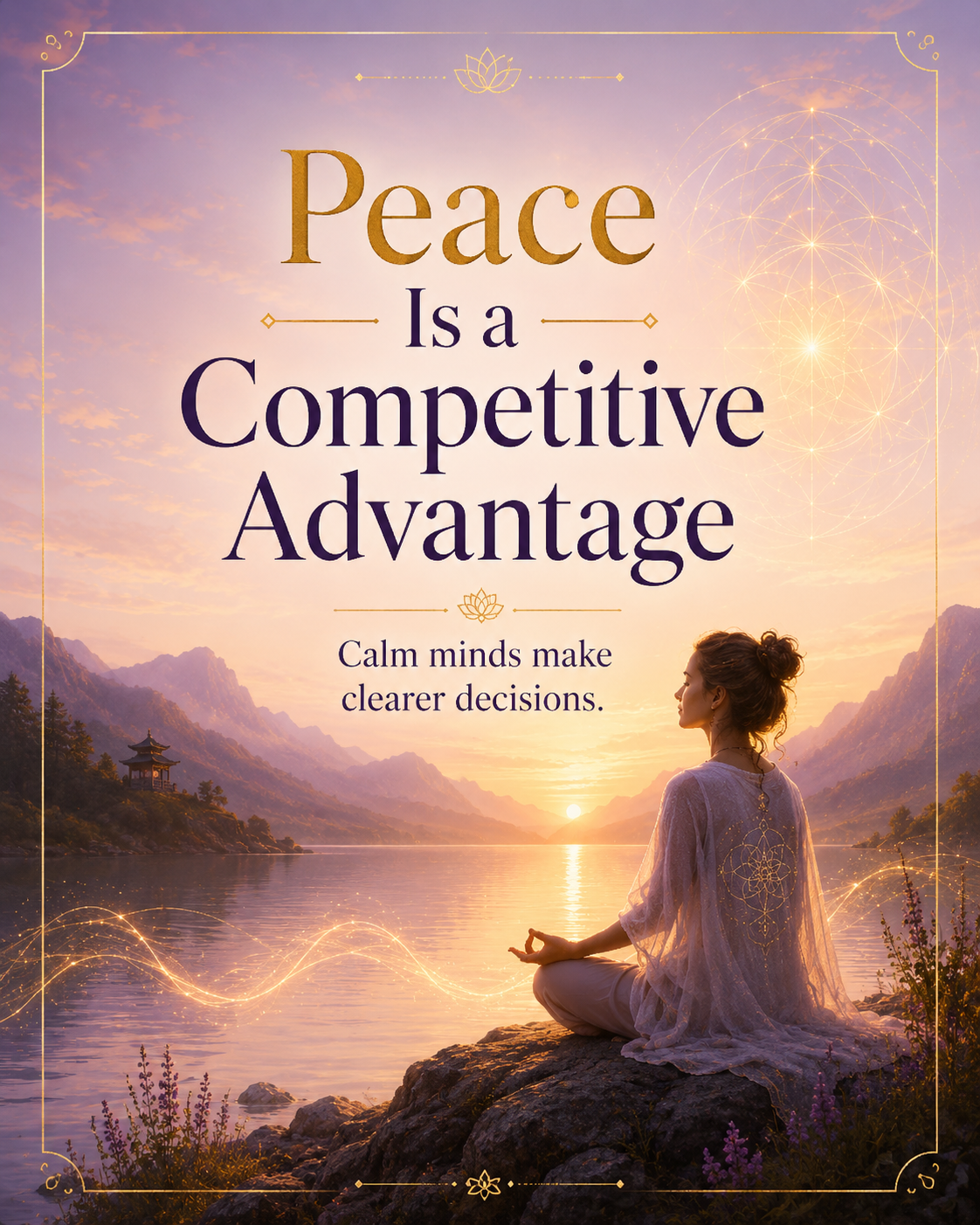
In a reactive world, peace becomes a competitive advantage.
Calm People See More Clearly
Stress narrows our field of vision.
When we feel threatened, rushed, or overwhelmed, the mind focuses on immediate survival. We become more reactive, more defensive, and more likely to choose relief over wisdom.
A peaceful mind creates space.
Space to notice what others miss.
Space to separate fact from fear.
Space to identify the real problem.
Space to consider the long-term consequence.
Space to hear the quiet signal beneath the surrounding noise.
This does not mean calm people avoid difficult decisions.
It means they make difficult decisions without allowing panic to make the decision for them.
Peace does not remove pressure.
It changes the way you carry it.
Urgency Is Not Always Importance
One of the most useful distinctions in life is the difference between something that is urgent and something that is important.
Urgency is loud.
Importance is often quiet.
Urgency says, “Answer this now.”
Importance says, “Think carefully.”
Urgency says, “Do something.”
Importance says, “Do the right thing.”
Urgency says, “Everyone is moving. You are falling behind.”
Importance says, “Stay aligned with what matters.”
The inability to tolerate a pause causes many avoidable mistakes.
We send messages we later regret.
We accept opportunities that do not fit.
We react to temporary emotions.
We make financial decisions from fear.
We confuse movement with progress.
The pause is not wasted time.
It is where discernment lives.
Peace Improves Performance
Peace is not the opposite of ambition.
It is what makes ambition sustainable.
A calm mind can remain focused longer. It can communicate more clearly, recover more quickly, and adapt without losing direction. It is less likely to waste energy fighting imagined threats or rehearsing problems that have not happened.
This matters in every part of life.
At work, peaceful people make better leaders because they do not spread panic.
In relationships, they listen before reacting.
With money, they are less likely to chase, fear, or make impulsive decisions.
In health, they understand that recovery is part of progress.
In faith, they become quiet enough to listen rather than constantly demanding an immediate answer.
Peace does not make you less effective.
It removes the internal interference that keeps you from operating at your best.
The Strongest Person in the Room
The strongest person in the room is not always the loudest.
It is often the person who does not need to prove anything.
The person who can hear criticism without immediately defending themselves.
The person who can face uncertainty without manufacturing false confidence.
The person who can remain steady when plans change.
The person who can say no without anger and yes without desperation.
The person who can walk away from an opportunity that compromises their values.
That kind of composure is difficult to manipulate.
When you are governed by fear, people can control you through pressure.
When you are governed by approval, they can control you through praise or rejection.
When you are governed by urgency, they can control you through deadlines and artificial scarcity.
But when you are grounded in peace, your decisions come from a deeper place.
You stop reacting to every signal.
You become responsible for your own state.
Peace Must Be Practiced
Most people do not suddenly become peaceful when pressure arrives.
They return to the internal patterns they have rehearsed.
That is why peace must be practiced before it is needed.
It is cultivated in small moments:
Taking one slow breath before responding.
Beginning the morning without immediately reaching for your phone.
Leaving space between meetings.
Walking without headphones.
Praying before making an important decision.
Allowing silence into a conversation.
Sleeping before deciding something that can wait.
Refusing to treat every inconvenience as an emergency.
These practices may seem small, but they train the nervous system and the mind to remain steady.
Peace becomes less of an occasional feeling and more of an internal posture.
You Do Not Need to Attend Every Emergency
Not every problem deserves your immediate energy.
Not every opinion deserves a response.
Not every invitation deserves a yes.
Not every conflict deserves escalation.
Not every thought deserves belief.
Not every emotion requires action.
Part of protecting your peace is learning to identify what actually belongs to you.
You may be carrying responsibilities that were never yours. You may be absorbing other people’s anxiety, expectations, and urgency. You may be spending your best attention solving problems that do not move your life forward.
Peace requires boundaries.
A boundary is not a wall against life.
It is a decision about where your attention, energy, and responsibility begin and end.
A Peaceful Life Is Not a Problem-Free Life
Peace is not the promise that nothing difficult will happen.
It is the confidence that difficulty does not have to dictate your inner condition.
There will still be pressure.
There will still be uncertainty.
There will still be disappointment.
There will still be moments when the path forward is unclear.
But you can meet those moments differently.
You can breathe before reacting.
You can pray before deciding.
You can seek truth before assuming.
You can choose patience without becoming passive.
You can act with strength without abandoning gentleness.
Peace is not found by controlling every circumstance.
It is found by becoming less controlled by circumstance.
A Practice for This Week
Before responding to anything that creates tension, pause for ten seconds.
Take one slow breath and ask:
Does this require my immediate reaction, or does it deserve my considered response?
That question creates space between stimulus and action.
Inside that space, you regain choice.
You may still need to act quickly. You may still need to have a difficult conversation, make a firm decision, or confront a real problem.
But you will do it from clarity instead of chaos.
That is the advantage.
In a world that profits from keeping you anxious, distracted, and reactive, peace is an act of strength.
It protects your attention.
It sharpens your judgment.
It steadies your relationships.
It improves your leadership.
It allows you to move through pressure without becoming pressure.
The world will continue to be loud.
Your advantage is learning not to become loud inside.
Protect your peace.
Practice it.
Carry it into every room.
Because calm minds make clearer decisions—and clear decisions create better lives.
— Abundant Current
Forward this Current Brief to someone who could use a little more peace this week.